Coming home can feel like the hardest part of your day, but it doesn't have to.
You walk through the door after a long day of helping others—clients, patients, students, coworkers.
You’re met with questions, emotions, noise, and needs.
You love your family. But your nervous system is shot.
You’re tired. Snappy. Disconnected. Or maybe just numb.
You wish you had more capacity. More softness. More time.
But the to-do list doesn’t end at work—it stretches into dinner, laundry, and late-night overthinking.
This was built for you.
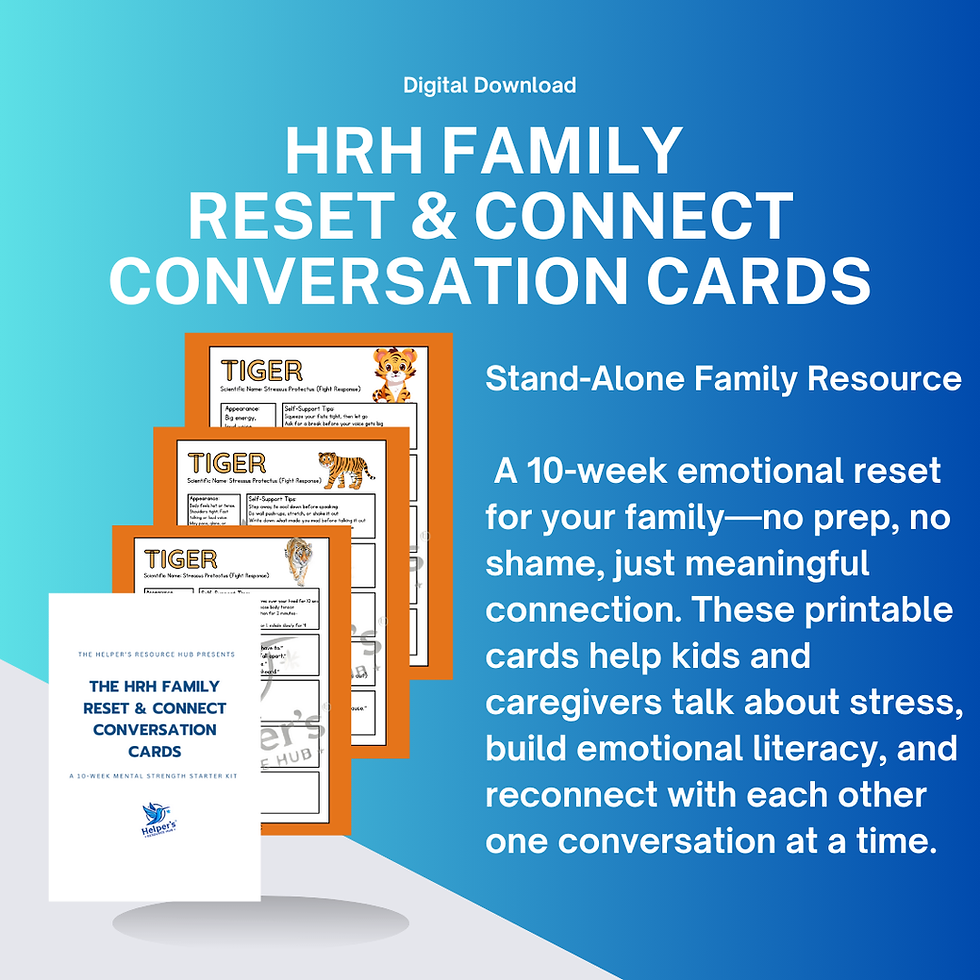
The HRH Family Reset & Connect Conversation Cards
Trauma-Informed Parenting Tools That Actually Work at Home
Parenting is hard. Parenting through trauma, stress, or burnout? Even harder. That’s why our family resources are designed for everyday caregivers navigating real-life challenges. Whether you’re parenting through grief, behavioral differences, trauma histories, or just want more connection and less conflict, Helper’s Resource Hub provides tools that are flexible, supportive, and easy to use—right from your phone, tablet, or printer.
Built for Real Life
You don’t need to prep a lesson, read a manual, or become a trauma expert. This kit was made for caregivers who love deeply but are tired, overwhelmed, or unsure where to start.
What It Is
-
A 25-page digital guide with 10 front-and-back connection cards (one per week)
-
15 kid-friendly Stress Animal Cards that teach the four core stress responses (fight, flight, freeze, and fawn)
-
30 minutes of guided connection each week—just print, read, and begin
-
Designed for use on your phone, tablet, or as printed pages
-
No special training or prep required
Why It Matters
This is more than a conversation tool—it’s a trauma-informed parenting starter kit. Caregivers quickly learn to recognize stress responses, repair emotional moments, and co-regulate with kids through empathy and structure.
Who It’s For
-
Foster families and trauma-impacted households
-
Families facing big transitions, chronic illness, grief, or behavioral struggles
-
Homes navigating ADHD, autism, or sensory sensitivity
-
Caregivers seeking fewer shutdowns and more connection
Family Norms that Heal, Not Harm
Traditional trauma leaves us with unspoken rules like: Don’t talk. Don’t trust. Don’t feel.
We help families replace those with healing norms like:
-
Safe Hands & Feet
-
Encouraging Words
-
Respect Ourselves, Others, & Our Surroundings
These positive norms promote emotional safety, co-regulation, and healthy conflict repair—even in homes with limited time, bandwidth, or literacy levels.
What You’ll Learn Together
-
Identify your family’s unique stress response patterns
-
Build emotional language using the Stress Animals Model
-
Understand how stress affects memory, flexibility, and focus
-
Create "calm corners" and co-regulation plans at home
-
Develop family values and communication habits that grow with your kids
-
Practice real repair skills and emotion coaching that supports long-term healing
What Makes It Different
This isn’t something you read alone at midnight and try to implement by yourself. It’s a shared experience—something the whole family can walk through together.
It redistributes emotional labor. It invites your kids not just to behave, but to belong.
You don’t need to be a perfect parent. You just need a place to begin. This is it.
Ready to Change How Your Family Connects—for Good?
If your home feels heavy with stress, short tempers, or silence… you're not alone. And you’re not doing it wrong.
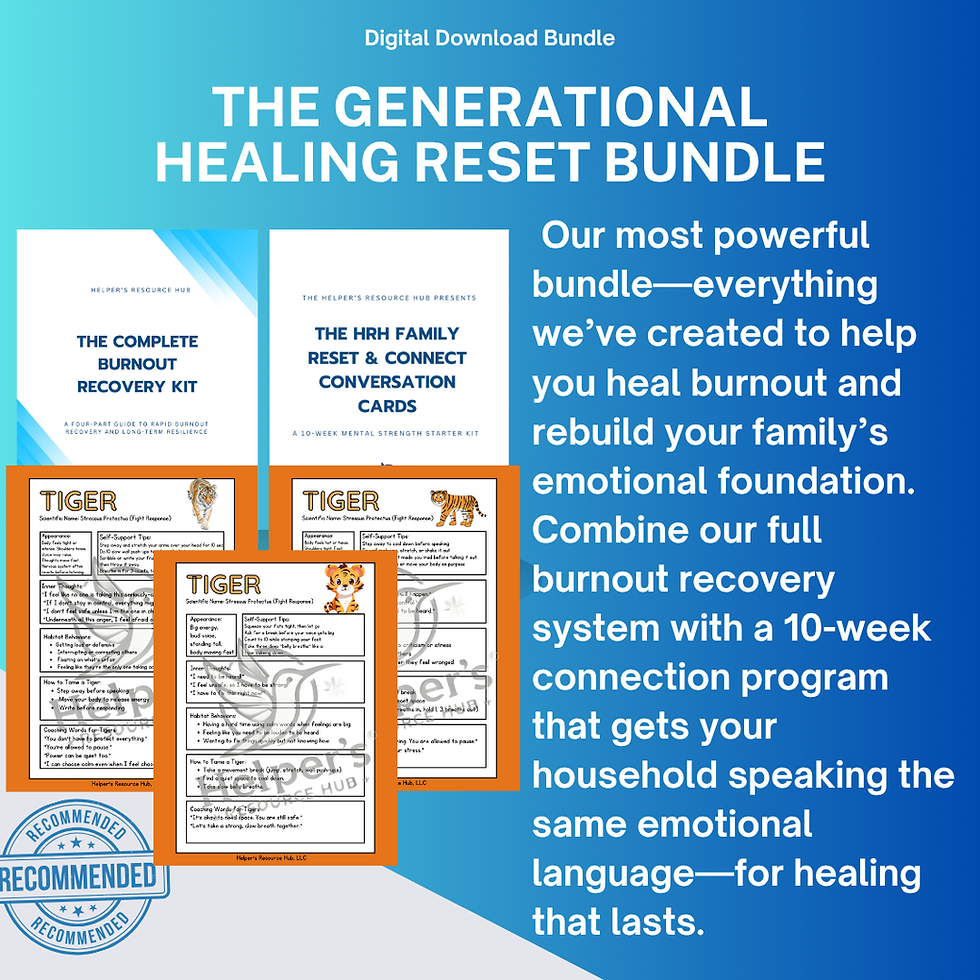
The Generational Healing Reset Bundle is your complete roadmap for transforming family culture. Whether you use it on paper or on-screen, these tools help you:
-
Stop reactive patterns before they pass down
-
Model emotional safety and boundaries
-
Build a connected, compassionate home
One semester. One guide. One household transformed.
Free Tools, Always.
We believe access matters. That’s why we offer free resources on our website and TPT store—because we know caregivers often spend their own money trying to support their kids. From our "Protect the Protector" burnout reset to printable family connection cards, you’ll always find something that meets you where you are, without a paywall in the way.
Let’s reset together. Because your family deserves tools that heal—not just hold things together.
%20(2).png)
Wondering If Our Resource are Right for Your Family?
If you're like many families today, you're trying to show up as a healthier caregiver—often while juggling chronic stress, emotional exhaustion, or unresolved patterns from your own upbringing.
These resources are here to support you.
Our materials are designed to help your home become a trauma-informed environment, one where emotional safety is prioritized, generational trauma can begin to heal, and children can thrive.
Please review the links to explore how trauma impacts child development, behavior, and learning. Each one offers practical insight to help you support your child’s emotional needs and build a more connected, resilient family system.
Stanford Children’s Health – Childhood PTSD
A brief medical overview of PTSD symptoms and prevalence in children.
Stanford Children’s Health – Childhood PTSD
A brief medical overview of PTSD symptoms and prevalence in children.
NPR – Understanding the ACEs Quiz
Learn how early stressful experiences may still influence your health, behavior, and relationships.
Neurodivergent Insights – ADHD and Trauma
Learn how trauma and neurodivergence often overlap in the classroom.
Neurodivergent Insights – Autism and Trauma
Understand how trauma uniquely affects autistic individuals and may influence behavior and coping.
Alexandra Massey – Family Roles and Rules
Explore the hidden roles children adopt in dysfunctional families.
Patrick Teahan – The 6 Parent Archetypes
Understand how common parent dynamics impact child development.